Video and Audio Run Level. Almost Nobody Only Watches.
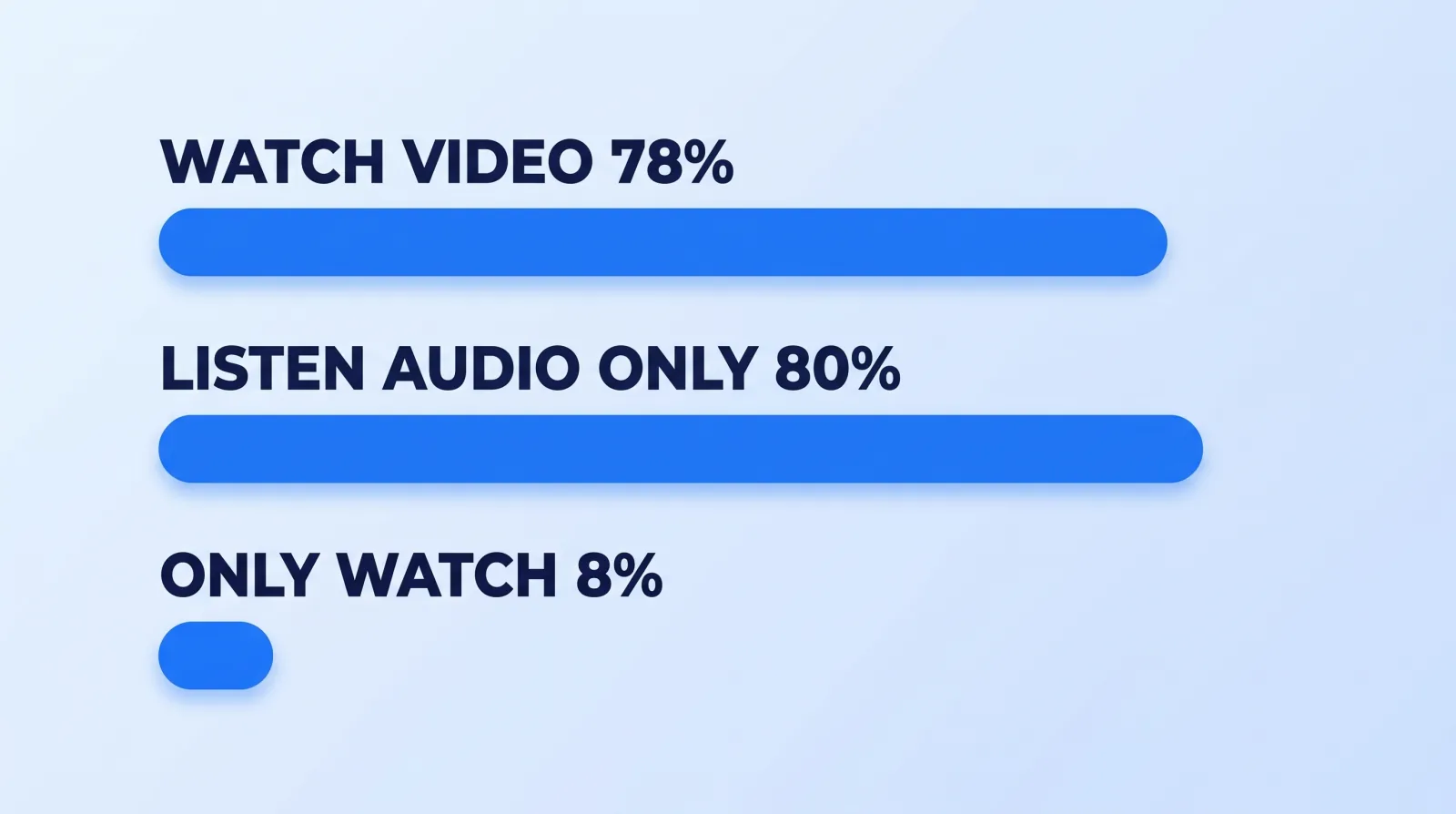
Among U.S. weekly podcast consumers in the first quarter of 2026, 78% consume podcasts with video they actively watch and 80% consume audio-only podcasts, according to Edison Podcast Metrics. Video briefly came out ahead in Q3 2025 — 82% against audio's 78%, the first crossover in Edison's tracking — and that quarter produced a lot of headlines about podcasting becoming a video medium. The more decision-useful number came from Cumulus Media and Signal Hill Insights the following spring: only 8% of weekly podcast consumers say they only watch, while 92% say they listen.
So this is not a question of audio versus video. Both formats now reach nearly the entire weekly audience, and most people move between them depending on what they are doing. The real question is narrower: what a video version adds to your show, what it costs per episode, and whether the edit you pay for still works for the listeners who never look at the screen.
Mark Studios does not run shoots. We cut what shows record — more than 10,000 editing projects behind 200M+ views and over $10M in client revenue — and podcast video is where we watch this decision go wrong most often. The usual shape: a host adds a camera, uploads the raw recording unedited, sees nothing move in three months, and concludes video does not work for their show. Every figure below is checked against its source on our video podcast statistics page.
What Publishing Video Actually Buys You
Three things, and it is worth being specific about which one you are buying.
Distribution on platforms that only index video. YouTube says more than 1 billion people watch podcasts on it every month. On living-room devices alone, viewers watched over 700 million hours of podcasts in October 2025, up from 400 million hours a year earlier. Spotify says more than 500 million users have streamed a video podcast, up nearly 50% year over year, and Apple introduced a video podcast experience in Apple Podcasts in February 2026. An audio-only show is invisible on all of it.
Portability between formats. Sounds Profitable found that 73% of podcast listeners would follow a creator from audio to video. Among adults who already consume both, 37% lean toward video, 34% have no preference and 29% lean toward audio — a split, not a stampede.
Raw material for everything else. Once a camera is running, every episode also produces vertical clips, which is the cheapest reach a podcast gets. That is a separate workflow with its own economics, covered in how to repurpose long-form video into shorts.
| Where it lands | Reach signal | What the episode has to be |
|---|---|---|
| YouTube | 1B+ monthly podcast viewers; 37–44% name it their most-used podcast platform | Full episode, chapters, a real thumbnail per release |
| Spotify | 500M+ users have streamed a video podcast | Video delivered to the show; payouts run through its Partner Program |
| Apple Podcasts | Video experience launched Feb 2026, app available in 170+ countries | A video file delivered through your host |
| Smart TVs | 38% of weekly consumers use one, up from 32% a year earlier | A frame that still reads from ten feet away |
The television number is the one most shows underestimate. Edison found that 13% of weekly podcast consumers now name a TV as their primary podcast device, up from 1% in 2021. A television is a big screen that people frequently are not looking at — it is a speaker in the corner of the room as often as it is a monitor.
The Edit Has to Work With the Screen On and With It Off
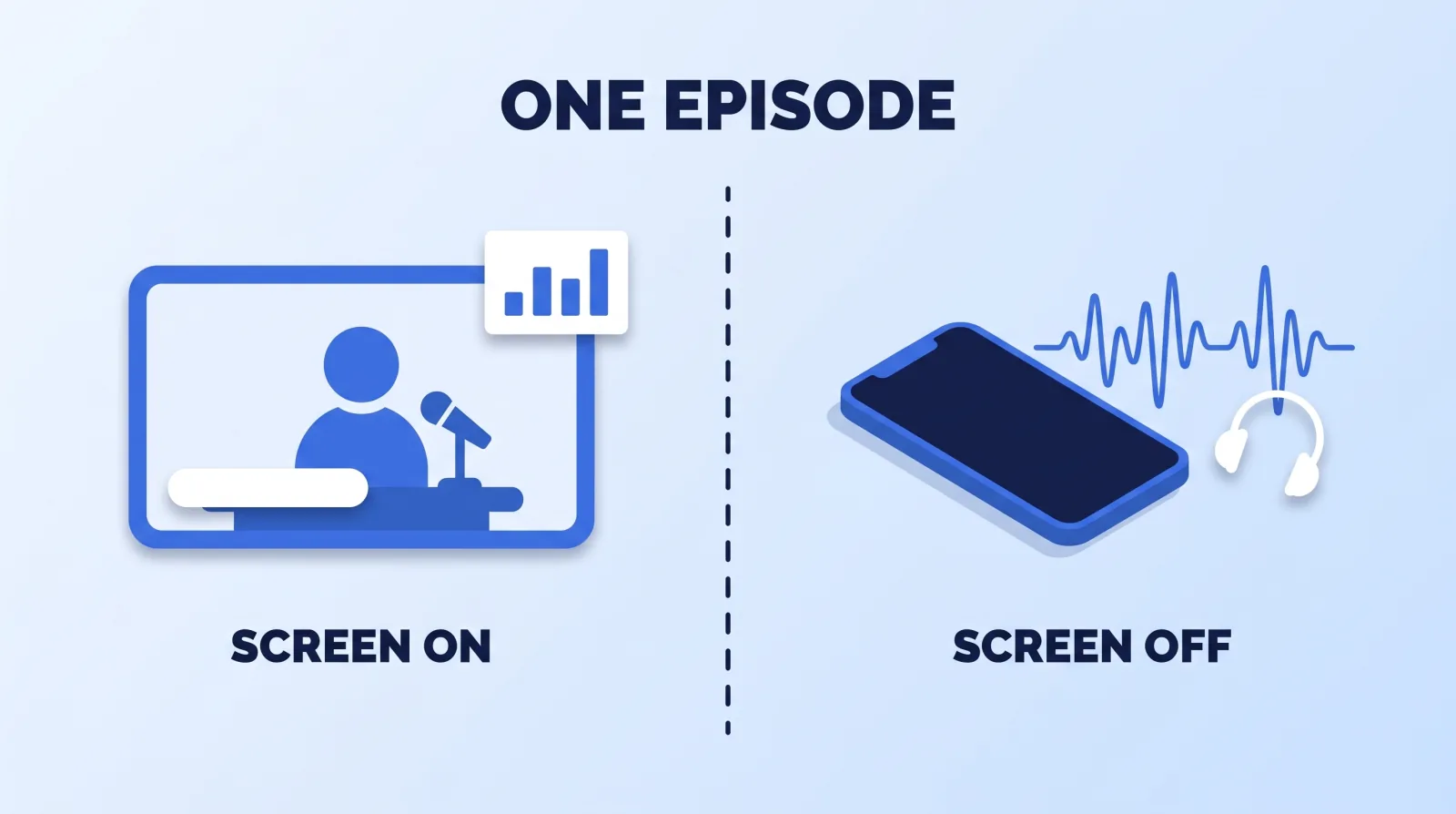
This is the constraint that separates a video podcast that works from one that annoys both audiences. Cumulus and Signal Hill found that 49% of weekly podcast consumers prefer to actively watch while listening, and a steady 30% prefer the video running in the background while they listen. Those two groups are watching the same file.
Four rules follow, and we build every podcast edit around them:
- Nothing load-bearing goes on screen alone. If a guest points at a chart, the host says the number out loud. "As you can see here" is a sentence that fails for the majority of your audience.
- Graphics reinforce, they do not inform. A name card, a figure appearing as it is spoken, a chapter title — all of these add for a watcher and cost a listener nothing. Full-screen text that replaces speech does not. Where the line sits is the subject of motion graphics that earn their place.
- The audio master is still the deliverable that matters. Levelled, de-noised, mixed for headphones and for a phone speaker. A video podcast with a bad mix is a bad podcast with pictures.
- Caption the video version. It is required for the smart-TV and sound-off contexts and it is cheap; the format choice is covered in burned-in vs closed captions.
Three Levels of Commitment, and What Each One Costs
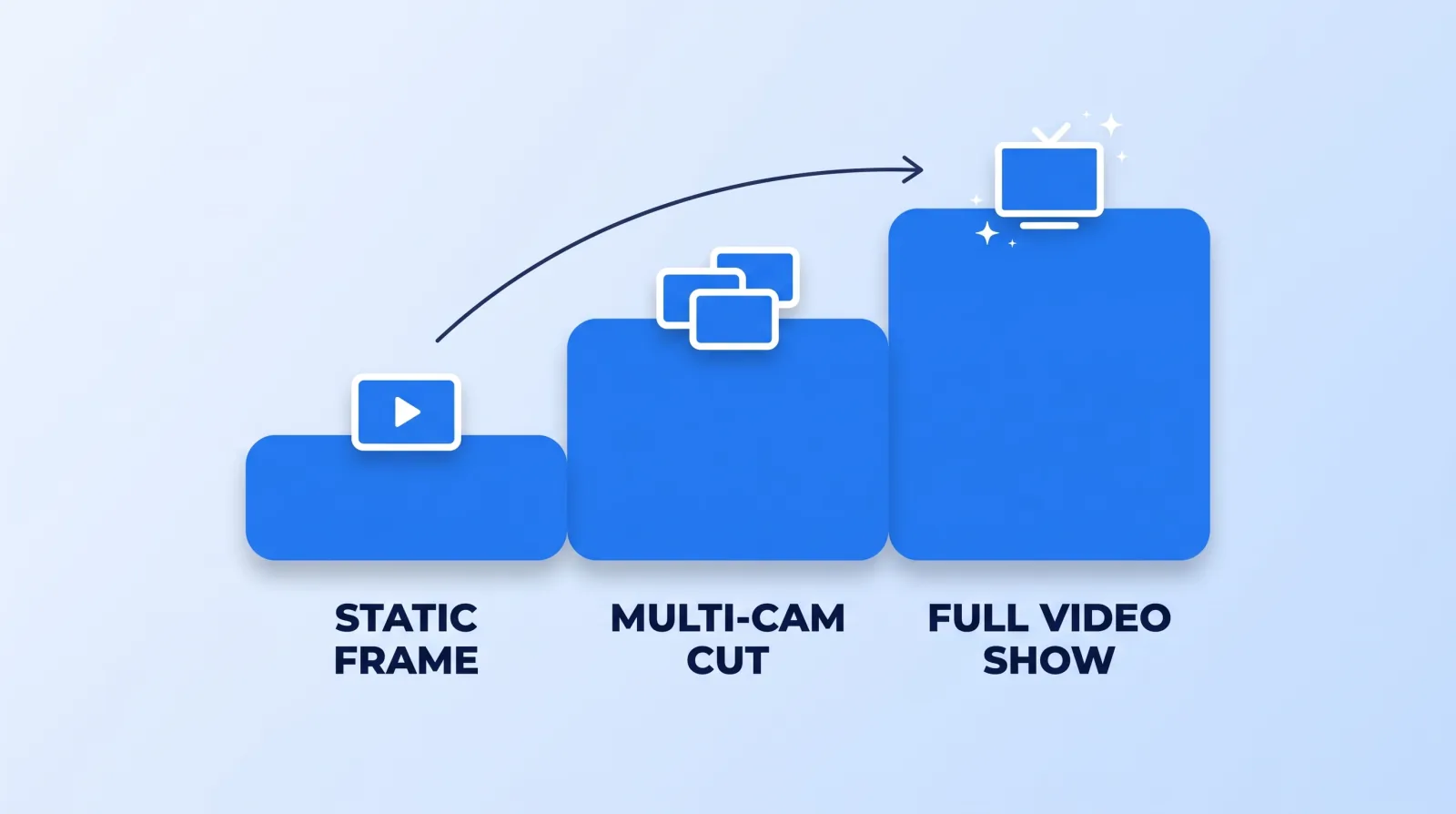
"Should we do video" is really three different decisions with three different bills. Most shows should start at the bottom and earn their way up.
| Level | What it is | Edit work per episode | Who it suits |
|---|---|---|---|
| Static frame | One locked wide shot, topped and tailed, audio cleaned, uploaded whole | Minimal — close to the audio edit you already pay for | Any show testing whether video moves anything at all |
| Multi-cam cut | Two or three angles switched on who is speaking, dead air tightened, names on screen | Moderate; the multi-cam podcast workflow is the reference | A show with a regular co-host or guests |
| Full video show | Cutaways, graphics, chapters, a designed thumbnail, vertical clips cut from the same session | The largest line item; priced like any video editing engagement | A show where video is a growth channel, not a mirror |
The jump that catches people out is from the first row to the second. A static frame is nearly free because there is nothing to decide. A multi-cam cut requires someone to make a switching decision every few seconds for an hour, every week, forever. That is a recurring commitment rather than a project, and it is the point at which most hosts stop doing it themselves.
Seven Questions That Decide It
Run these before you commission anything. If you cannot answer the first one, the rest do not matter.
- What does video show that audio cannot? Demonstrations, products, reactions, screen shares, a guest's face doing something the words do not carry. "People expect it" is not an answer, and it produces the episodes nobody watches.
- Will the full episode go up, or only clips? Clips are a different product with a different cost, and a show can do clips-only for a year before committing to full video.
- Does the frame hold for sixty minutes? A static shot is judged by the room, the lighting and the framing, all of which an edit can adjust only slightly.
- Who cuts it, week after week? This is the question that kills video podcasts — not the camera, the cadence.
- What happens to the audio feed? It stays first. The RSS episode should never be the video's leftovers.
- Can you commit to twelve episodes? Fewer than that and you will not have enough data to judge whether video did anything.
- What will you measure? Views on the video platform, yes, but also whether audio downloads moved. If video only cannibalises your own listeners, you paid for a format change, not growth.
Where the Editing Actually Comes From
Most shows land on one of three options: the host cuts it, a freelancer does, or a studio does. For a weekly show the deciding factor is rarely quality on episode one — it is whether the same standard arrives on episode forty when the host is travelling. Marketplace hiring works for a pilot and pushes the vetting onto you; the trade-offs are laid out in our freelance marketplace comparison, and how to vet a video editing service covers the paid trial and the red flags.
Whichever you pick, ask for one thing specifically: a sample where the episode was cut to work with the screen off. It is the only test that separates someone who edits video podcasts from someone who edits video. Our podcast video editing service and the wider work we do for podcasters are both built around that constraint.
The Bottom Line
Video and audio now reach almost the same weekly audience, and only 8% of podcast consumers watch exclusively — so a video version is an addition to your show, never a replacement for the audio feed. Start with a static frame and a clean mix, name the thing video actually shows that audio cannot, and only climb to a multi-cam or fully produced edit once twelve episodes of data say the screen earned it.